Non-Woven Shopping Bags
Who these are for
Supermarkets & grocery
A carrier that replaces dozens of single-use bags. Specify 80–90 gsm with reinforced cross-stitched handles and expect years of weekly use.
Retail chains
Branded carriers at the till, often in two sizes. Laminated versions are used where the bag doubles as retail packaging.
Promotions & events
High-volume handout at the lowest workable cost. 60–80 gsm with a one or two colour screen print.
Loyalty & membership
Bags sold or given at a threshold spend, where perceived quality reflects on the programme.
Specification range
Choosing the fabric weight
Under-specifying weight is the most common and most expensive mistake in this category, because a bag that fails on its third use has cost more than the heavier fabric would have.
What drives your unit price
Fabric weight
The largest single input. Moving up a weight band raises fabric cost and carton weight together.
Bag size and gusset
Price tracks the total fabric area, so a deeper gusset costs more than the dimension suggests.
Colour count
In screen printing each colour is a separate screen and a separate pass. Reducing four colours to two often saves more than negotiating.
Handle construction
Cross-stitched webbing handles cost more than die-cut and are worth it wherever weight is carried.
Quantity
Setup cost is amortised across the run, which is why unit price steps down at quantity breaks.
Production and inspection
Bags in this category are produced in an SGS-verified facility in Wenzhou. Fabric weight and tensile strength are verified on the incoming roll, dimensional and stitching checks run at intervals through the line, handle pull testing is performed per machine setup, and shipment release requires a pre-shipment inspection using ISO 2859-1 AQL sampling.
GSM guide
What each fabric weight actually carries, and what it costs.
Printing methods
Screen, transfer, lamination and digital compared.
Order process
The five stages from enquiry to delivery.
Request a quote
Specification-based pricing in one business day.
Frequently asked questions
What size should I order?
Start from what the bag has to hold. If you are replacing an existing bag, measure it flat: width, height, and gusset depth. We build to your dimensions rather than to a stock size list, so there is no penalty for specifying exactly what you need.
How many times can a non-woven shopping bag be reused?
It depends almost entirely on fabric weight and handle construction. An 80–90 gsm bag with cross-stitched handles handles weekly grocery use for a long period; a 60 gsm die-cut bag is a single-event item. Specify for the reuse you actually expect.
Can I have a photographic design printed?
Not directly onto raw non-woven at an acceptable quality. For photographic artwork the route is a laminated bag, where the image is printed on film and laminated to the fabric.
Do you offer bags in custom fabric colours?
Yes. Non-woven is produced in a wide colour range and custom colour matching is possible at sufficient volume. Fabric colour also affects how printed ink reads, so tell us the intended combination early.
What is the minimum order?
It varies by construction and print method rather than being a single fixed number. Your minimum and the quantity breaks are confirmed in your quotation.
Can these be made from recycled material?
Yes. Recycled-content PP and RPET fabric are both available. Where you need a verified recycled-content claim, the certification is arranged per order and confirmed in writing before production.
Further reading
Laminated vs unlaminated non-woven bags — what BOPP film adds, what it costs, and when to leave it off.
Ultrasonic welding vs stitching — which seam fails first, and how to specify the joining method.
Bag size and gusset — how to write width, height and gusset so the bag fits the product.
Tell us the load, the quantity range and your destination market, and we will specify the bag and price it.
Showing 49–51 of 51 results
-

Portable Non-Woven Gift Bag – Custom-Print Reusable OEM
-

Portable Non-Woven Gift Bag (6-Colour) – Custom-Print Reusable OEM
-
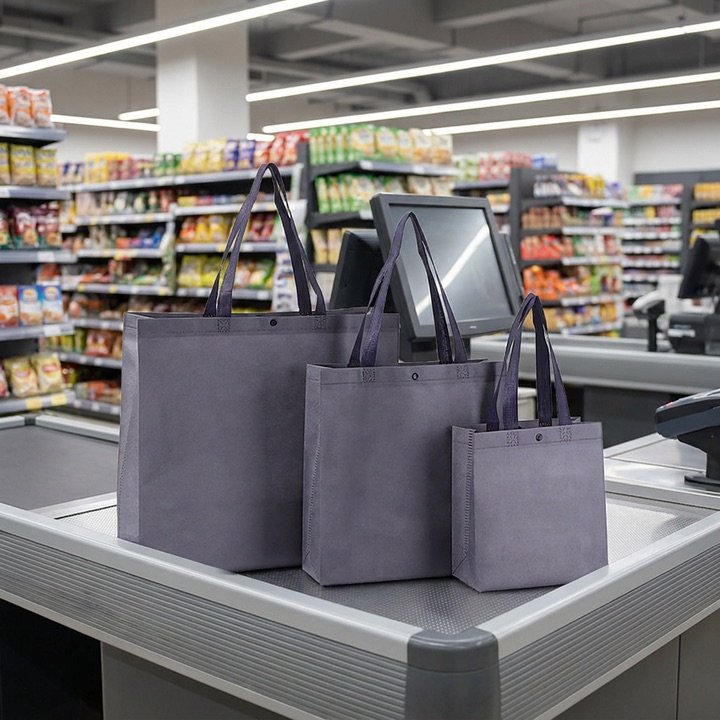
Reusable Non-Woven Tote Bag with Logo
How to Specify Custom Non-Woven Shopping Bags
Custom non-woven shopping bags are reusable carriers for supermarkets, fashion retail, trade shows and promotional campaigns. A clear brief should state the finished dimensions, side or base gusset, fabric GSM and colour, handle dimensions, reinforcement, print coverage, expected load and order quantity.
Bag Style and Printing
Standard totes provide a familiar retail format, laminated bags support photographic graphics, and box constructions create more packing volume. Screen printing is efficient for simple logos and spot colours; lamination is usually preferred for full-coverage artwork. Fabric weight should be judged together with seams and handle attachment.
Sample Approval
- Fit and load-test the intended products
- Confirm handles and gussets when the bag is filled
- Approve colour and print position
- Check folding, bundle count and carton packing
Compare laminated non-woven bags and non-woven tote bags, then send your specification.