Courier & Mailing Bags
What sits in this category
A mailing bag is one of the lowest-cost components in your fulfilment chain and the one most likely to generate a customer-service ticket. It has to survive automated sortation, being thrown into a van, sitting in rain on a doorstep and then being opened by someone who forms an opinion about your brand while they do it. Everything below is about matching film, thickness and closure to that journey rather than buying the lightest option and absorbing the damage rate.
Mailer types compared
Choosing film thickness
Thickness is stated in mil (thousandths of an inch) or in microns. Going heavier than necessary adds cost and shipping weight on every parcel you send; going lighter than necessary shows up as a split rate you will only notice weeks later.
If you do not know where you sit, send us a sample of the heaviest and the sharpest thing you ship. Specifying from an actual product beats specifying from a category name.
Closures and features
Printing on film
Film prints very differently from fabric or paper. Ink sits on a non-absorbent surface, so coverage is even and colours stay bright, but registration tolerance on high-speed lines is looser than on offset paper.
Materials and environmental claims
Plant-starch films based on PBAT and PLA, and films containing recycled polyethylene, are both available. These materials behave differently in transit: plant-starch films are generally less tear-resistant at the same thickness and have a shorter shelf life before the film begins to change. Where a project requires performance against a published standard such as EN 13432 or ASTM D6400, the film is produced against those test requirements and the certification and test reports are arranged for that specific order and confirmed to you in writing before production. We do not attach an environmental description to a product unless there is a document behind it that names your run.
What actually drives your unit price
Bag size
Film is priced by weight, so surface area and thickness together set the material cost before printing.
Film thickness
The single biggest material lever. A half-mil change across a large annual volume is significant money in both directions.
Number of print colours
Each colour is a plate on flexo. Consolidating a design changes short-run economics more than negotiation does.
Material choice
Plant-starch and recycled-content films carry a resin premium over standard co-extruded PE.
Closure and extras
Return strips, document pockets and serial numbering each add a component or an operation.
What to include in your enquiry
How orders are produced and checked
Mailer production is coordinated through an SGS-verified facility in Wenzhou and its audited film partners. Incoming film is checked for thickness and tensile strength before the line starts; bag dimensions, seal integrity, adhesive peel force and print registration are checked at defined intervals during production; and a pre-shipment inspection follows ISO 2859-1 AQL sampling before the shipment is released.
The five-stage order process
Enquiry, quote, artwork approval, production, inspection and shipping.
Quality & compliance
Every checkpoint, the method used and the AQL settings.
Printing methods explained
Flexo, digital and what each costs to set up.
Request a quote
Four questions to get a specification-based price.
Frequently asked questions
What thickness should I order?
For lightweight single garments the lighter end of the range is usually enough; most mixed e-commerce assortments settle in the middle; anything with a hard corner or multiple items wants the heavier end or a bubble lining. The reliable method is to send us the products rather than the category, and we will specify against them.
What is the minimum order quantity?
It depends on the size, the film, the print method and whether the size is a running one or has to be tooled. Stock-size bags with a simple print and fully custom plant-starch bags sit at very different points. Your minimum and the quantity breaks are set out in the quotation.
Can I get bags that the customer can reseal and return?
Yes. A double peel strip gives the recipient a second adhesive line below the one you sealed, so the same bag goes back without repackaging. It adds a small amount per unit and removes a return-packaging step for the customer.
Are plant-starch mailers as strong as standard poly?
Generally not at the same thickness. PBAT/PLA films tend to be less tear-resistant and more sensitive to heat and storage time. If you are switching, expect to move up a thickness step and to order against a shorter stock-holding cycle. We will say so in the quotation rather than after the first complaint.
Can you print on the inside of the bag?
Yes. Interior printing is a common way to make an inexpensive mailer feel considered when it is opened, and it costs less than most people expect because it uses the same press pass.
How long does production take?
Lead time is driven by quantity, film availability, print method and the number of proofing rounds. It is stated in your quotation and confirmed again on the order confirmation, measured from artwork and specification approval.
Further reading
Custom poly mailers for e-commerce — sizing, film thickness and closure options for shipping bags.
Bag size and gusset — how to write width, height and gusset so the bag fits the product.
Send us the product, the quantity and the destination. We will specify the film, closure and print and come back with a price.
Showing all 3 results
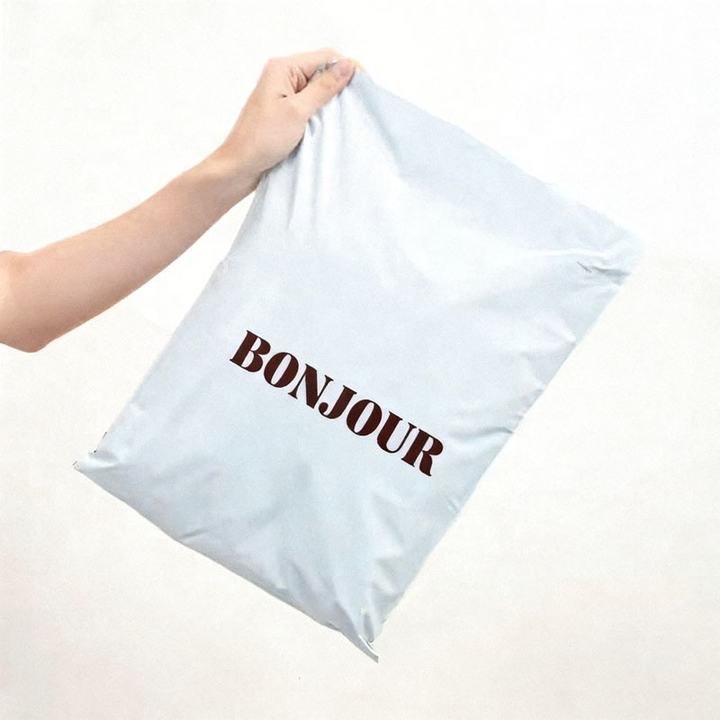


Custom Courier and Mailing Bags for E-Commerce Shipping
Courier and mailing bags should be selected around the product, delivery route and fulfilment process. Buyers need to define the usable internal size, film or paper structure, thickness, opacity, cushioning, closure strips, tear opening, printing, quantity and any environmental claim.
Match Protection to the Product
Flat poly mailers minimise weight for apparel and textiles. Bubble mailers add cushioning for smaller impact-sensitive goods. Compostable plant-starch mailers require clear certification and storage conditions. In every case, the internal packing area is smaller than the external size because seals and cushioning consume space.
Distribution Testing
- Fit the largest packed product
- Check seals, puncture resistance and tear opening
- Verify labels and barcodes scan correctly
- Approve artwork clear of seals and closures
Compare poly mailers, bubble mailers and compostable mailers, or send a shipping brief.
Frequently Asked Questions
- Should a mailer be specified by internal or external size?
- Use the required usable internal size because side seals, closures and cushioning reduce the available packing area.
- When should a buyer use a bubble mailer?
- Use cushioning for smaller impact-sensitive items; flat poly mailers are normally better suited to apparel and other soft goods.
- Which mailer tests matter before production?
- Test product fit, seals, puncture resistance, closure and tear opening, label adhesion, barcode scanning and representative handling.